A practical framework for HR, L&D, and people leaders who need measurable improvement in customer-facing team performance.
AI workforce intelligence is not just dashboard reporting. It is the operational ability to detect capability gaps, understand employee sentiment, and take targeted action quickly. For customer-facing teams, this is critical: communication mistakes affect revenue, retention, and brand trust in real time.
Most organizations still run training and employee feedback as separate programs. Training teams run roleplays and coaching cycles. HR teams run engagement surveys months later. The data rarely connects. Talenteria gives teams a chance to merge these loops by using AI simulation training to capture observed behavior and AI employee surveys to capture voice, sentiment, and context. Together, these create a stronger decision base for managers.
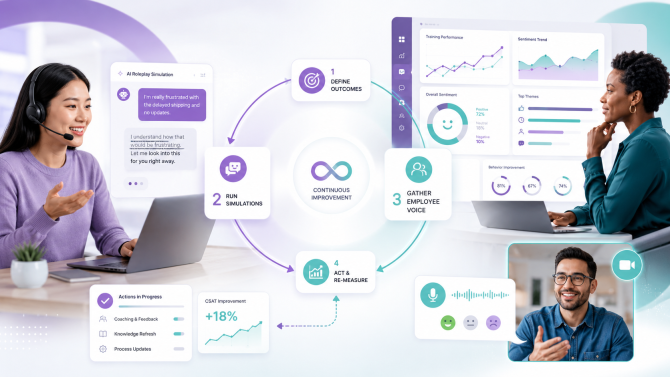
The 4-stage operating model
Stage 1 - Define priority outcomes
Start with operational outcomes, not generic learning goals. For example: reduce escalation errors, improve objection handling, or speed onboarding confidence for new agents. Pick two or three targets per quarter.
Stage 2 - Run realistic AI conversations
Talenteria’s simulation training flow supports uploading your own materials, generating scenarios, and running AI roleplay sessions where trainees respond in dynamic conversations. This gives behavior-level evidence, not only quiz completion data.
Stage 3 - Gather employee voice with context
After training cycles, run Talenteria AI employee surveys using conversational video or voice interviews. Templates can be used for onboarding, engagement, learning, career development, or change-related feedback. This captures what the team experienced and why confidence may still lag in specific situations.
Stage 4 - Act, then re-measure
Use AI-generated summaries, themes, and sentiment signals from surveys plus simulation scoring trends to adjust coaching priorities, manager cadence, or knowledge materials. Then run the next simulation cycle to verify improvement.
Practical example: support team onboarding in 30 days
A support organization onboarding 25 new agents can run this simple sequence:
Week 1: Upload FAQs, policy documents, and escalation rules; generate AI scenarios for common first-month issues.
Week 2: Run AI roleplays for angry-customer handling and policy exceptions; review communication and accuracy feedback.
Week 3: Launch conversational AI survey focused on onboarding clarity, confidence, and manager support.
Week 4: Compare scenario-level weak spots with employee sentiment themes; update scripts, coaching prompts, and knowledge materials.
This approach ties skill demonstration to lived experience. If simulation scores rise but survey sentiment shows low confidence, you know to focus on reinforcement and manager coaching rather than content volume.
Checklist: signals worth tracking monthly
- Scenario completion rates and retry patterns in AI simulations.
- Common communication breakdown themes in roleplay feedback.
- Survey participation rates by team or location.
- Sentiment and theme shifts after coaching interventions.
- Manager action completion on top three identified issues.
- Time-to-readiness for new hires in customer-facing roles.
How to do this in Talenteria
- Set your training objective and upload source materials, such as knowledge base articles, FAQs, and playbooks, in the AI simulation training workflow.
- Generate roleplay scenarios aligned to real customer interactions and run sessions for target teams.
- Use simulation feedback outputs, including scoring and improvement suggestions, to identify recurring skill gaps.
- Create an AI employee survey using a relevant template category such as onboarding, engagement, learning, or career development, then customize prompts for your context.
- Run conversational voice or video survey interviews so employees can respond naturally; review AI-generated transcription and analysis outputs for themes and sentiment.
- Build an action plan that links each top insight to a manager owner, a corrective intervention, and a check date in the next training cycle.
Talenteria Feature Spotlight
AI Simulation Training: Scenario generation from your own materials and dynamic customer-conversation practice.
AI Training Feedback: Session-level scoring, feedback, and improvement suggestions for communication quality and accuracy.
AI Employee Surveys: Conversational voice/video surveys instead of static forms, with ready-to-use template types.
Automated Survey Insighting: AI transcription, sentiment/theme analysis, and report outputs for faster action.
What changes when teams run one loop
With one loop, managers stop guessing where performance issues begin. Training data highlights observable behavior in roleplay. Employee voice data explains blockers that behavior data alone cannot reveal, such as unclear process ownership, policy ambiguity, or confidence gaps after difficult interactions.
When these signals are reviewed together, AI workforce intelligence becomes practical: you can prioritize interventions by business impact, assign accountable owners, and verify results in the next cycle. This turns AI from a pilot tool into a repeatable workforce operating system for HR and L&D teams.


