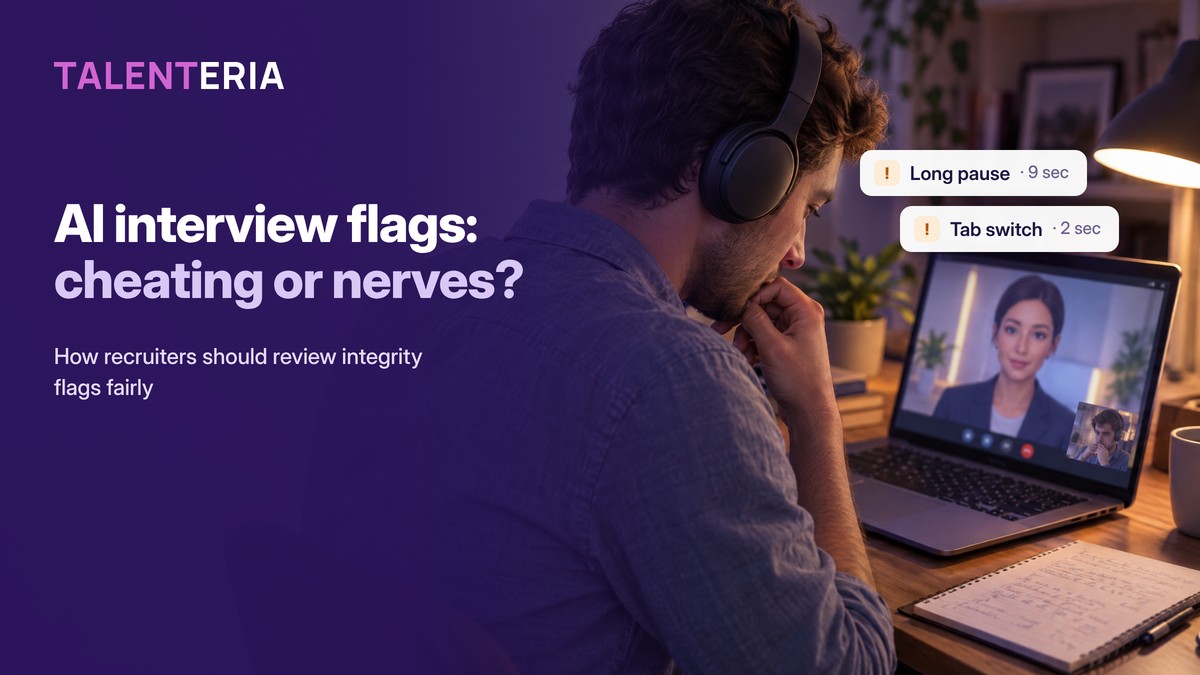
The interview report says a candidate switched tabs eight times, pasted text once and paused for 11 seconds before a key answer. Is that AI interview cheating, or a nervous candidate with notes open in another window? This guide gives you a weighted rubric for integrity signals, the arithmetic of how many flagged candidates are honest, and a three-tier review protocol with the wording to send candidates.
Why a flag is not a finding
Interview fraud is real and growing. In a 2025 Gartner survey of 3,000 candidates, 6% admitted to interview fraud, such as posing as someone else or having someone else pose as them. Gartner also predicts that by 2028, one in four candidate profiles worldwide will be fake (Gartner, July 2025). On proctored skills assessments, CodeSignal reports that detected cheating and fraud attempts rose from 16% in 2024 to 35% in 2025 (CodeSignal, Feb 2026). Note what that measures: flagged attempts on tests, not confirmed cheating in interviews.
That gap between flagged and confirmed is the whole problem. A tab switch, a long pause and a paste each have ordinary causes. Candidates are also unsure what is allowed: in Greenhouse’s 2026 candidate research, 80% of US candidates said employer AI policies are vague, rare or absent (Greenhouse, 2026). Someone reading their own notes in another tab may believe they are following the rules.
Both errors cost you. Miss real cheating and you hire someone who can’t do the job. Reject on a false flag and you lose a good candidate, and you may lose more of them from one group: second-language speakers pause longer, and some assistive tools switch windows.
What each integrity signal can and can’t tell you
Score each interview by signal type, not by raw event count. Eight tab switches before the first question are worth less than three in the middle of an answer.
| Signal | Ordinary causes | Points | Check |
|---|---|---|---|
| 1–2 tab switches | Notifications, own notes | 0 | Nothing |
| 3+ switches during answers | Notes, second screen | 1 | Timing vs. answers |
| Paste into typed answer | Own prepared notes | 2 | Length and wording |
| 1–2 long pauses | Thinking | 0 | Nothing |
| Long pauses on most answers | Second language, connection | 1 | Warm-up answer |
| Strong answers, weak follow-ups | Nerves | 2 | Transcript |
| Second screen or virtual mic | Normal desk setup | 1 | Pair with other signals |
| Rejoined mid-interview | Dropped connection | 0 | Answers after rejoining |
Add the points. 0–1 = Clear: decide on the interview score alone. 2–3 = Review: a recruiter reads the transcript around each flagged moment. 4+ = Verify: invite the candidate to a short live follow-up before deciding.
Three notes on reading the signals:
- Pastes: a 41-character link is not a 300-word finished answer. The strongest sign is pasted text that reads nothing like the candidate’s spoken answers.
- Pauses: compare against the candidate’s own first answer, not a fixed number. A pause that is long for one person is normal for another.
- Follow-ups: this is the only content signal, and the most useful. A polished answer that falls apart when asked for one more detail tells you more than any event count.
What never counts: eye movement, facial expression or “seeming nervous”. They don’t separate cheating from anxiety, and inferring emotions from faces carries legal risk in some places.
Worked example: 400 interviews in a month
Here is why a single flag can’t justify a rejection. The rates below are assumptions for illustration; replace them with your own once you have three months of data.
Say you run 400 AI interviews a month and 8% of candidates (32 people) get hidden live help. The other 368 do not.
- Any-flag rule: it catches 75% of helpers (24 people) and flags 20% of honest candidates (74 people). That is 98 flagged, of whom 74 (76%) are honest. Rejecting every flag rejects three honest candidates for each one who cheated.
- Rubric Review tier (2+ points): it catches 55% of helpers (18) and flags 3% of honest candidates (11). That is 29 flagged, of whom 11 (38%) are honest. Much better, but still too many to reject without a check, which is why the Verify tier exists.
- If cheating is rarer: at 2% (8 helpers), the any-flag rule flags 6 helpers and 78 honest candidates. 78 of 84 flagged (93%) are honest.
The tiers also save reviewer time:
| Approach | Work | Time |
|---|---|---|
| Deep-read every flag | 98 × 15 min | 24.5 h |
| Tiered review | Triage + review + calls | 14.5 h |
The tiered figure is 98 two-minute triages (196 min), 29 fifteen-minute reviews (435 min) and 12 twenty-minute verification calls (240 min): 871 minutes in total.
Track three numbers each month: interviews flagged, interviews verified, and cases confirmed. If fewer than 1 in 5 verification calls confirms anything, raise your thresholds. If one signal fires on more than 25% of interviews, look at the interview design first: a time limit may be too short, or candidates may have been told to keep notes open.
A three-tier review protocol for AI interview cheating flags
Give every tier an owner and a deadline, so flagged candidates aren’t left waiting while honest ones move ahead.
Tier 1: Triage (recruiter, within 1 business day, about 2 minutes)
Score the interview with the rubric. At 0–1 points, mark it “integrity reviewed, clear” and decide on the score, using the same cut-offs you use for everyone (how to set weights and cut-off scores).
Tier 2: Review (recruiter, within 2 business days, about 15 minutes)
Open the transcript and recording at each flagged timestamp and answer three questions:
- Did the switches happen during answers, or between questions?
- Does any pasted text match how the candidate speaks elsewhere?
- Did the candidate handle the follow-up questions on their own answers?
In Talenteria, the interview report holds the score, criterion ratings, AI summary, transcript and video together, so this review happens on one screen.
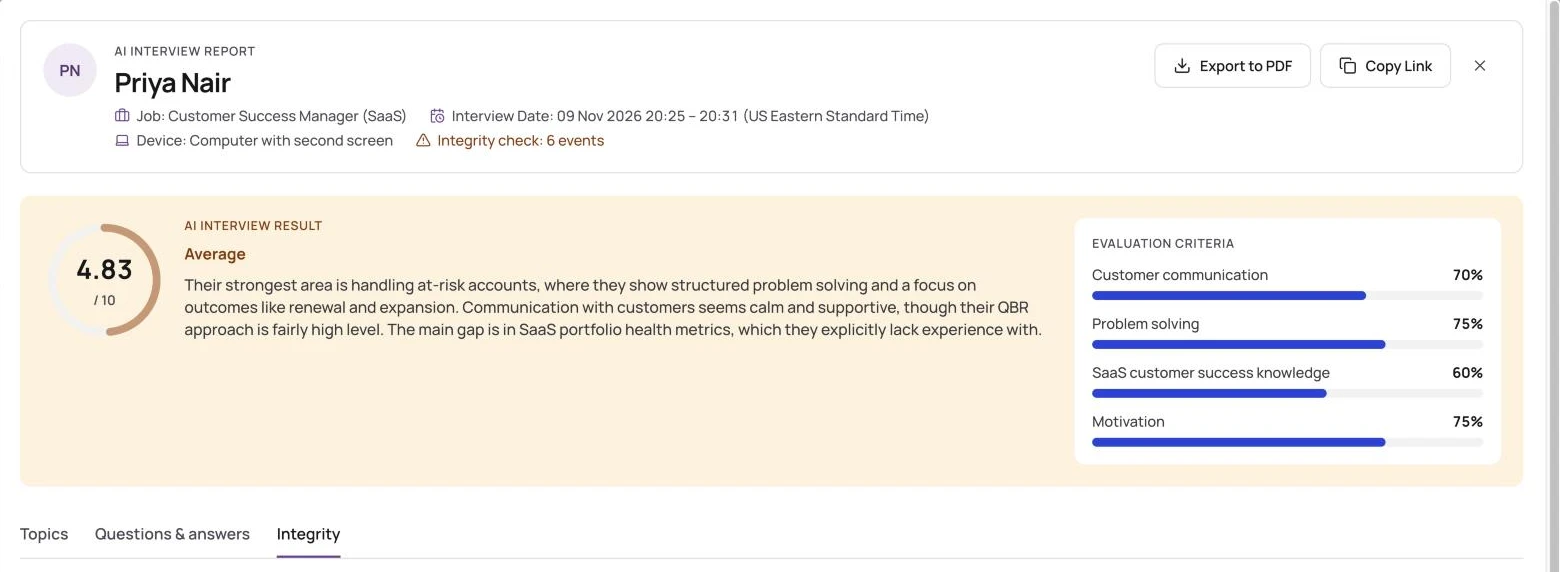
The report header shows the score, the device and the integrity count side by side. The integrity events don’t change the score.
End the review with one of two outcomes: Clear, or Verify.
Tier 3: Verify (second reviewer, within 3 business days, 15–20 minutes)
Book a short live video call with the hiring manager or a second recruiter. Don’t open with the flag. Use a script like this:
“Thanks for completing the interview. We’d like 15 minutes to go deeper on two of your answers. In your answer about [topic], you mentioned [detail]. Walk me through how you did that, step by step. What would you change if you did it again?”
Someone who did the work can go one level deeper without effort. Two reviewers must agree before anyone is rejected on integrity grounds.
Document every decision
Record the signals and timestamps, the points, what you checked, the outcome, the reviewer and the date. Keep the note with the interview record. If a decision is ever challenged, this note is your evidence that a person reviewed it.
Tell candidates the rules before the interview
Most false flags come from unclear rules, so publish yours in the interview invitation and repeat it on the start screen. Draw the line between preparing and getting help during the interview. Here is a clause you can adapt:
Using AI in this interview. You can prepare any way you like, including with AI tools, and you may keep your own notes nearby. During the interview, please answer in your own words: don’t use AI tools, other people or pasted text to produce your answers. The interview records window and tab switches, copy-and-paste events and long pauses. A record never rejects anyone on its own: a recruiter reviews it and may invite you to a short live follow-up. If you need an adjustment, such as extra time or typing instead of speaking, tell us before you start at [contact].
The accommodation line matters. A candidate using a screen reader, or answering in a second language, should be able to say so before any signal is recorded against them.
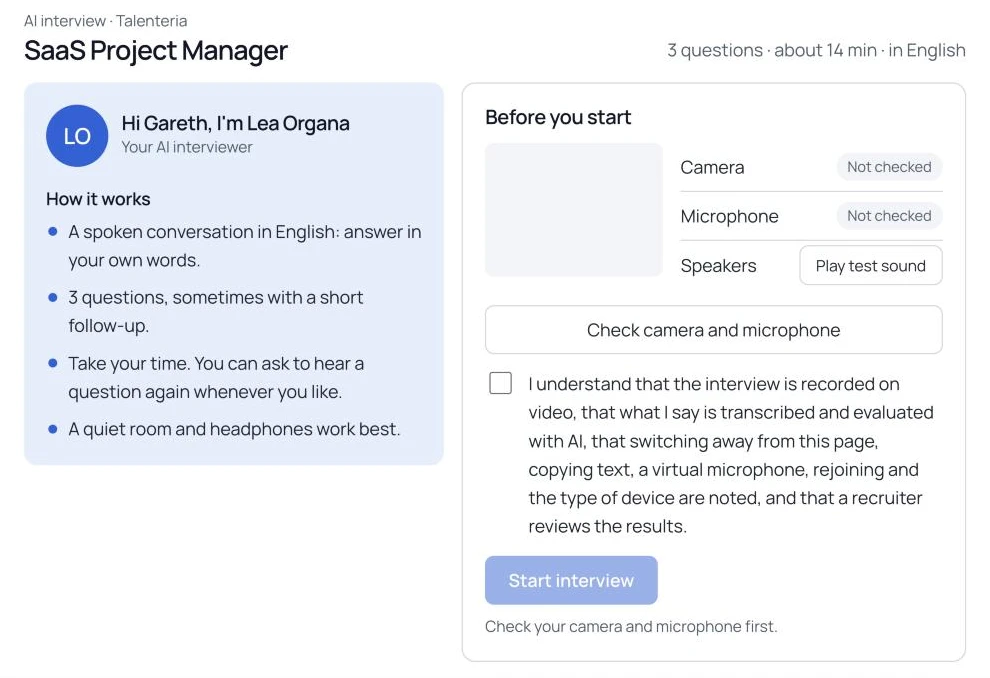
Before starting, candidates confirm they understand what is recorded and noted, and that a recruiter reviews the results.
How to do this in Talenteria
Talenteria AI video and voice interviews run a structured first round as a live conversation. The AI works through a framed set of questions generated from the job and reviewed by your recruiter, discusses each answer and follows up when it needs more depth, then scores the answers. Candidates answer by video, voice or text, and interviews can run in multiple languages.
Each report includes an integrity check. It counts window and tab switches, copy-and-paste events and long response pauses (over seven seconds), and the start screen tells candidates it also notes a virtual microphone, rejoining and the type of device, such as a computer with a second screen. Every event is listed with its time from the start, the question it happened on and the raw details.
Here is how the rubric reads the report below. The tab switch lasted two seconds and happened during the introduction (0 points). The copy event was a copy, not a paste into an answer (0). The three pauses of 9 to 15 seconds fell on two questions, not most of them (0). The second screen adds 1. Total: 1 point, so the interview is Clear, and the 4.83 score is judged on its own merits.
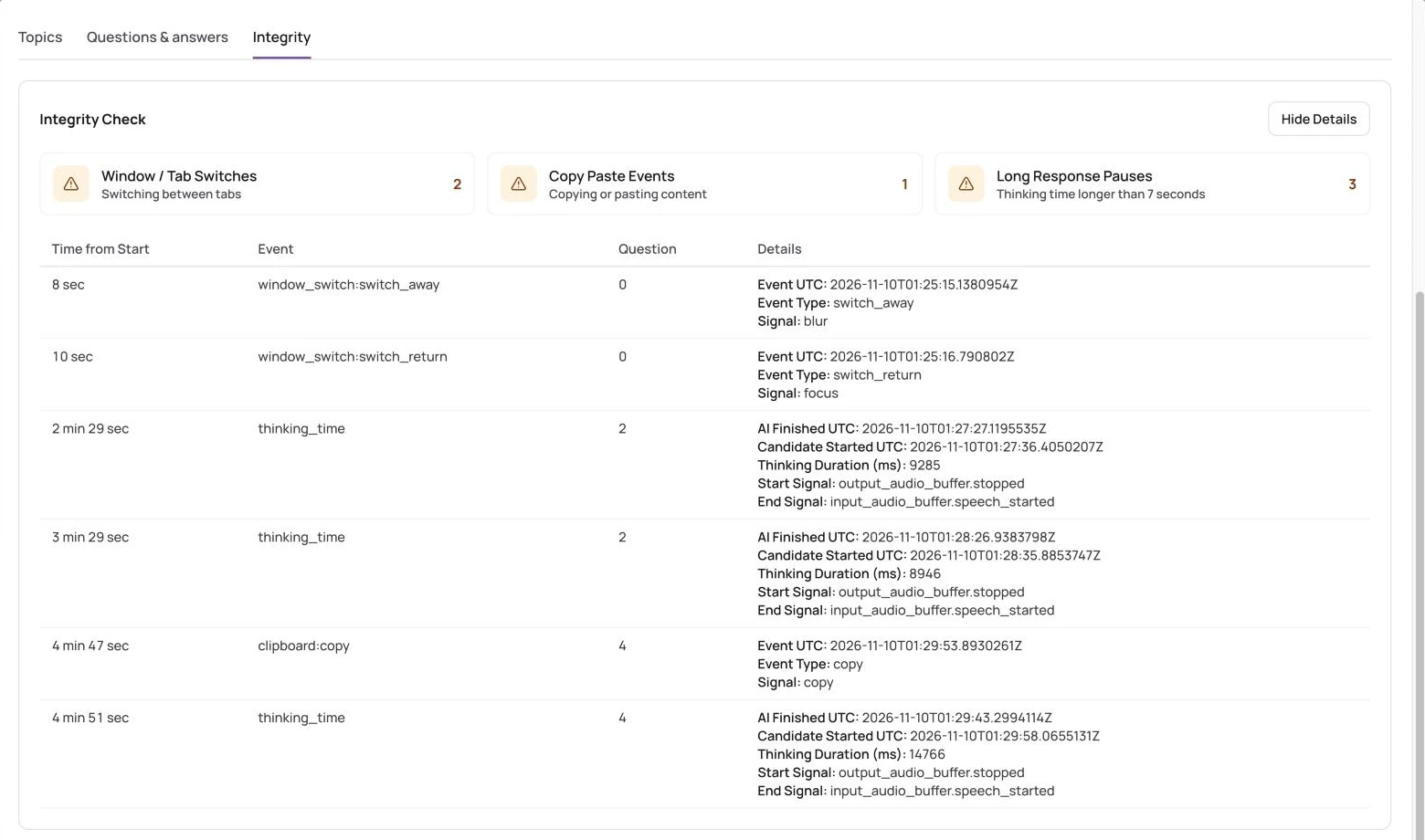
Six events, one point on the rubric: a two-second switch before the first question, one copy and three pauses of 9 to 15 seconds.
The integrity check records events and reports them; it does not change the candidate’s score and never rejects anyone. It runs the same way for every candidate, with no settings to tune, so the report means the same thing across a hiring round. What to do with it is a recruiter’s call, which is where the rubric and tiers above come in.
Before they start, candidates are told how the interview works and what the integrity check records, so the rules in your policy clause match what they see on screen. To run the protocol, use the counts for Tier 1 points, then open the details and transcript for Tier 2. Because the AI already asks follow-ups in the interview, the “strong answers, weak follow-ups” signal is in the transcript before you book a call.
Before you act on a flag
- Points scored by signal type, not raw counts
- Pauses compared with the candidate’s own first answer
- Transcript read at every flagged timestamp
- Verification call held before any integrity rejection
- Second reviewer agreed
- Decision note filed with the interview record
AI interview cheating is worth catching, but a flag only tells you where to look. Score signals by type, check the transcript, verify with a short live call, and tell candidates the rules up front. You’ll catch the candidates who can’t do the work without losing the ones who can.
Talenteria runs structured AI interviews with follow-up questions, scored reports and integrity checks, so your recruiters review evidence instead of guessing. See how it works at talenteria.com.