Time to proficiency is the number of days from a new agent’s first day of training until they perform like your tenured agents, without help. Some teams call it speed to proficiency or ramp-up time. Most contact centers report it as an average of the agents who got there. That average leaves out everyone who quit or stalled, so it looks better every time attrition rises. This guide shows a cohort method that counts every starter, with a worked 20-agent example and the cost of each ramp day.
What time to proficiency measures, and where the clock stops
Start the clock on day one of new-hire training, not on the first live call. Stop it when the agent meets every proficiency standard for 10 consecutive scheduled shifts. A single good week is noise; two steady weeks is a result.
Count training, nesting and the ramp on the floor. Training-only numbers hide most of the time: in ProcedureFlow’s 2021 survey of 155 contact centers, most programs ran 3–6 weeks of training, yet over a third of centers said agents needed 5–7 months to reach full proficiency. Fewer than 10% got there in under two months.
Use working days, not calendar days, so holidays and part-time schedules don’t distort the comparison between classes.
Step 1: Define “proficient” with five numbers, not a manager’s feeling
Proficiency is relative. Set each threshold against the median of agents with six or more months of tenure on the same queue, then check it once a quarter.
| Metric | Proficient when | Example target |
|---|---|---|
| QA score | ≥ 95% of tenured median | 84 (tenured 88) |
| Handle time | ≤ 115% of tenured median | 6:54 (tenured 6:00) |
| First contact resolution | ≥ tenured median − 5 pts | 66% (tenured 71%) |
| Help requests | ≤ 10% of contacts | ≤ 4 of 40 |
| CSAT | ≥ tenured median − 3 pts | 83% (tenured 86%) |
The 71% FCR in the example is the 2022 industry average from SQM Group’s benchmark. Use your own tenured median if you have it. The help-request line means the agent handles at least 9 of 10 contacts without tapping a supervisor or neighbor; log it with a one-click “asked for help” code, or you won’t have the data.
Two rules keep the scorecard honest. First, all five must hold on the same 10 shifts; an agent who hits QA in week 6 and handle time in week 9 is proficient in week 9 only if QA still holds. Second, don’t loosen a threshold mid-class. If a whole class misses one metric, that’s a training finding, not a reason to move the bar.
Step 2: Track the whole starting class, not just the finishers
Here is a realistic class of 20 agents, followed for 90 working days.
| Outcome | Agents | Working days |
|---|---|---|
| Reached proficiency | 12 | 38, 41, 44, 46, 49, 52, 55, 58, 63, 67, 74, 88 |
| Left before proficiency | 5 | Left on days 12, 19, 27, 33, 51 |
| Still ramping at day 90 | 3 | Not yet proficient |
The usual report averages the 12 finishers: (38 + 41 + 44 + 46 + 49 + 52 + 55 + 58 + 63 + 67 + 74 + 88) ÷ 12 = 56.25 days. The median of the finishers is 53.5 days. Both numbers describe the agents who succeeded and ignore 8 of the 20 people you hired.
Report three numbers instead:
| Measure | How to calculate | This class |
|---|---|---|
| Cohort median | Day the 10th of 20 starters is proficient | Day 67 |
| Day-90 yield | Proficient by day 90 ÷ starters | 60% (12 of 20) |
| Pre-proficiency loss | Left before proficiency ÷ starters | 25% (5 of 20) |
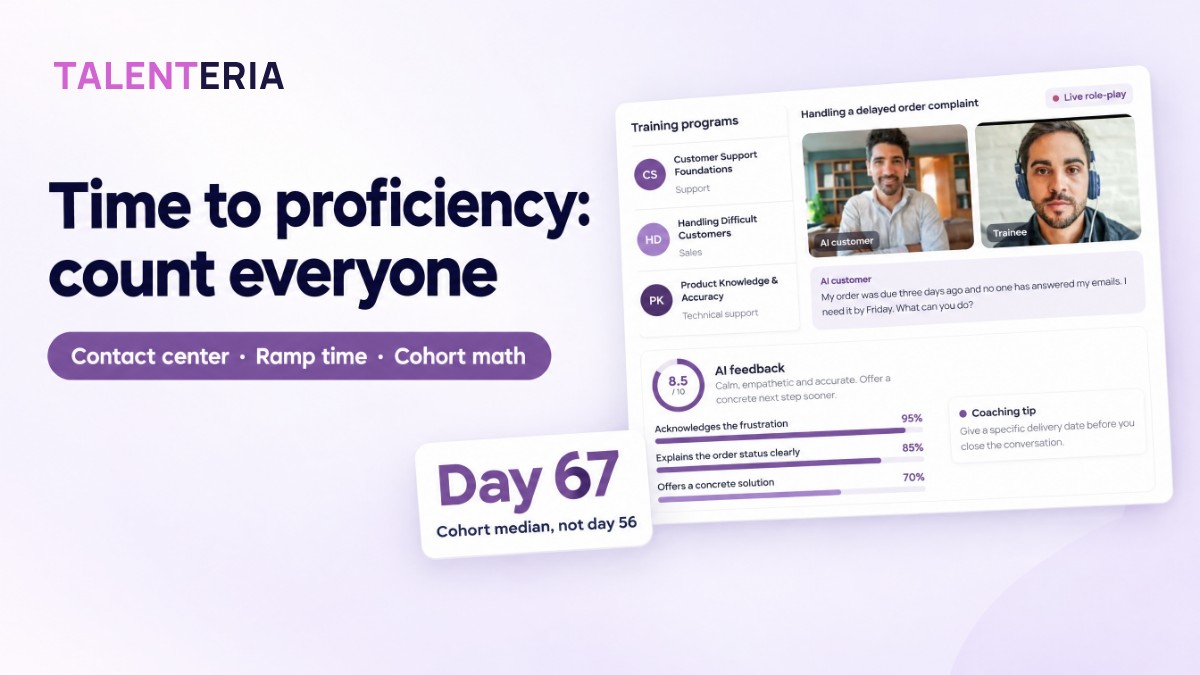
The cohort median answers the real question: by what day is half of the class you paid for working at full standard? Here it is day 67, about 11 days later than the average suggests. The day-90 yield works like a recruiting yield ratio, one stage further down the funnel. If fewer than half the class ever gets there, the cohort median is “not reached.” That’s the clearest warning sign this metric can give you.
This matters more now than it used to. In Verint’s State of Agent Experience 2026 survey of 1,000 agents, 31% said they were likely to leave their role within six months. When early attrition rises and the slowest learners are the ones who leave, the finishers-only average improves. The cohort median and the yield move the other way, which is the direction that matches your staffing reality.
Step 3: Put a price on each ramp day
Price the ramp with paid days per proficient agent, not per hire. Assume $18 an hour for 8 hours, or $144 per working day, wages only.
- Finishers: 675 paid days until proficiency
- Leavers: 142 paid days before they left
- Still ramping: 3 × 90 = 270 paid days
- Total: 1,087 paid ramp days = $156,528
Divide by the 12 agents who became proficient: $13,044 per proficient agent. The finishers-only view (56.25 days × $144) suggests about $8,100. The gap of almost $5,000 per agent is the cost of attrition and slow ramps hiding inside the average.
Use the same math to size improvements. For this class, every day you take off the finishers’ ramp is worth 12 × $144 = $1,728. Ten days is $17,280 per class of 20, before counting trainer time or the productivity drag on the tenured agents who answer the new hires’ questions. Cutting pre-proficiency loss from 5 agents to 2 often saves more than any training tweak.
Step 4: Read the three numbers and fix the right stage
Each pattern points to a different stage of the pipeline.
| What you see | Likely cause | First fix |
|---|---|---|
| Loss > 20% in training | Job not as expected | Realistic job preview in hiring |
| Loss spikes in nesting | First live calls overwhelm | Practice hard calls before go-live |
| Median OK, yield < 70% | Long tail of stragglers | Day-45 review per agent |
| Handle time met last | Agents can’t find answers | Fix knowledge base search |
| QA met last | Behaviors not coached | Weekly scored call reviews |
Check the scorecard in the order agents usually pass it. Help requests and QA tend to clear first, handle time last. If one class breaks that order, look at what changed for that class: a new product, a new trainer, or a policy update that the training materials don’t cover yet.
Compare classes on the cohort median, never on the average. Give each class at least 90 working days before you call its yield, and keep a “still ramping” column instead of dropping those agents from the report.
Add a readiness gate before agents reach the live queue
The cheapest ramp days to remove are the ones spent learning hard calls on real customers. ICMI documented a training team that replaced classroom content with realistic call scenarios and step-by-step support materials. After training, agents had needed about 45 more days to reach proficiency; with the new approach they needed 15, a 75% cut.
A readiness gate turns new agent readiness into a pass/fail check. Before nesting, each agent must:
- Pass the five most common contact reasons in practice calls, scoring at or above your QA threshold twice in a row.
- Answer policy questions correctly against your knowledge base at least 85% of the time.
- Handle one escalation scenario, such as a refund denied by policy, without breaking policy.
Track gate scores next to the five floor metrics. If agents who passed the gate on the first try reach proficiency faster, the gate is working. If gate scores don’t predict anything, rewrite the scenarios. For the first month after go-live, a 30-day onboarding plan that pairs practice with weekly feedback keeps the coaching going.
How to do this in Talenteria
Talenteria AI Training lets new hires practice the readiness gate with AI customers. You upload your knowledge base articles, FAQs and playbooks, and the platform generates scenarios from basic to advanced. Trainees practice by voice or text with personas such as a frustrated customer or a confused user.
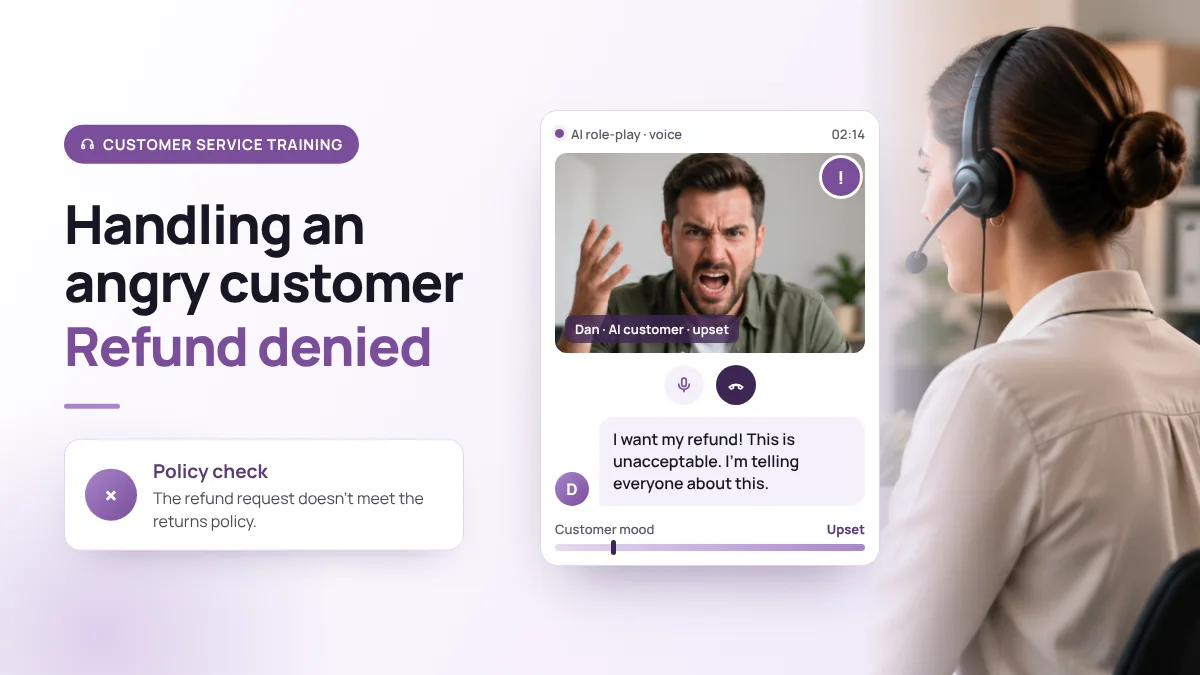
A voice role-play for the “refund denied” escalation, with the customer’s mood tracked live.
After each session, the trainee gets scores for empathy and tone, ownership, and knowledge accuracy, plus suggested better responses. Answers are checked against your own materials, and gaps are flagged with the source document. Managers see each hire’s progress, scores and weakest topics, and decide when each hire joins the live queue.
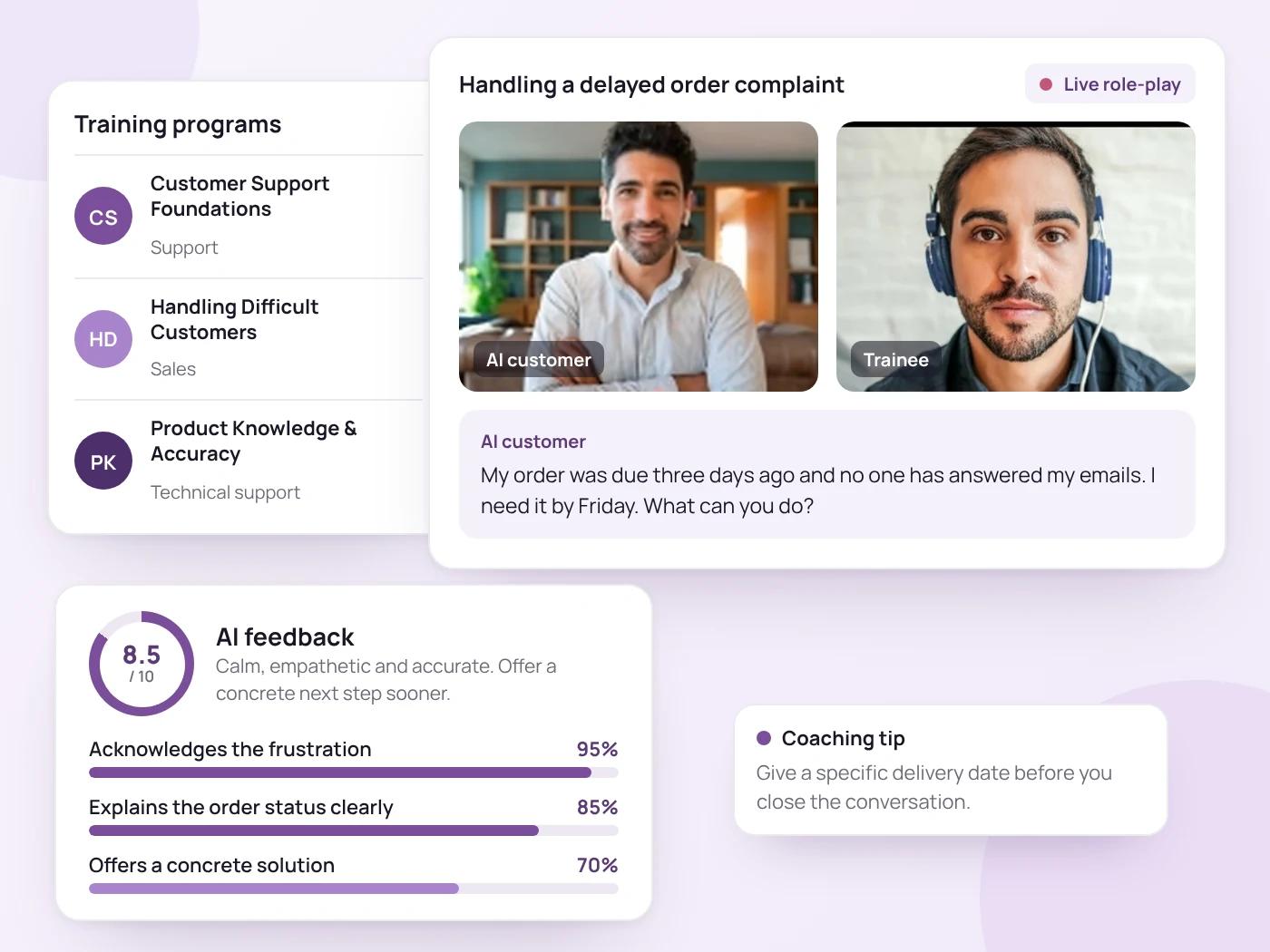
Session feedback breaks the score into specific behaviors, so coaching targets the weakest one.
Conclusion: report time to proficiency the way you staff
Time to proficiency is only useful if it counts everyone you hired. Report the cohort median, the day-90 yield and the pre-proficiency loss for every class, and price the ramp per proficient agent. Then fix the stage the numbers point to, starting with practice before the live queue.
Want to see how a readiness gate with AI role-plays would work for your support team? Explore Talenteria and start a free trial.