Multilingual AI interviews let a candidate in Lisbon and a candidate in Toronto answer the same questions in the language they speak best, at any hour. That only helps if a 7.5 in Portuguese means the same thing as a 7.5 in English. If it doesn’t, you have built a faster way to screen out good people in one market.
The fix is not complicated. It comes down to a short setup before you launch a new language, and a 30-minute review once a month.
Why scores drift between languages
Two candidates who give equally good answers should get the same score, whatever language they use and whatever accent they have. Three things break that:
- The question changed in translation. A literal translation can be harder, vaguer or more formal than the original.
- The scorer rewards delivery, not content. A criterion like “speaks clearly and confidently” quietly becomes an accent test.
- The reviewer can’t read the answer. A recruiter who doesn’t speak the language can’t tell a strong answer from a well-written summary.
This is not hypothetical. A University of Washington team tested four leading audio AI models on job-interview answers read in five English accents. The models ranked American and British accents highest and Chinese and Nigerian accents lowest, even when the content was identical and the speech was transcribed accurately.
Before you launch a language: 3 steps
1. Make language its own criterion. Decide which language the job actually needs, and at what level. If a support lead in Madrid needs Spanish for escalations, add “Spanish for customer escalations” as a separate scored criterion. Everything else (coaching, problem solving, product knowledge) can be answered in any language, and the interview language should not change those scores.
This matters legally too. The US EEOC says that acting on an accent requires evidence that the accent materially interferes with job performance. A vague “communication” score that drops for accented speakers is exactly what that standard catches.
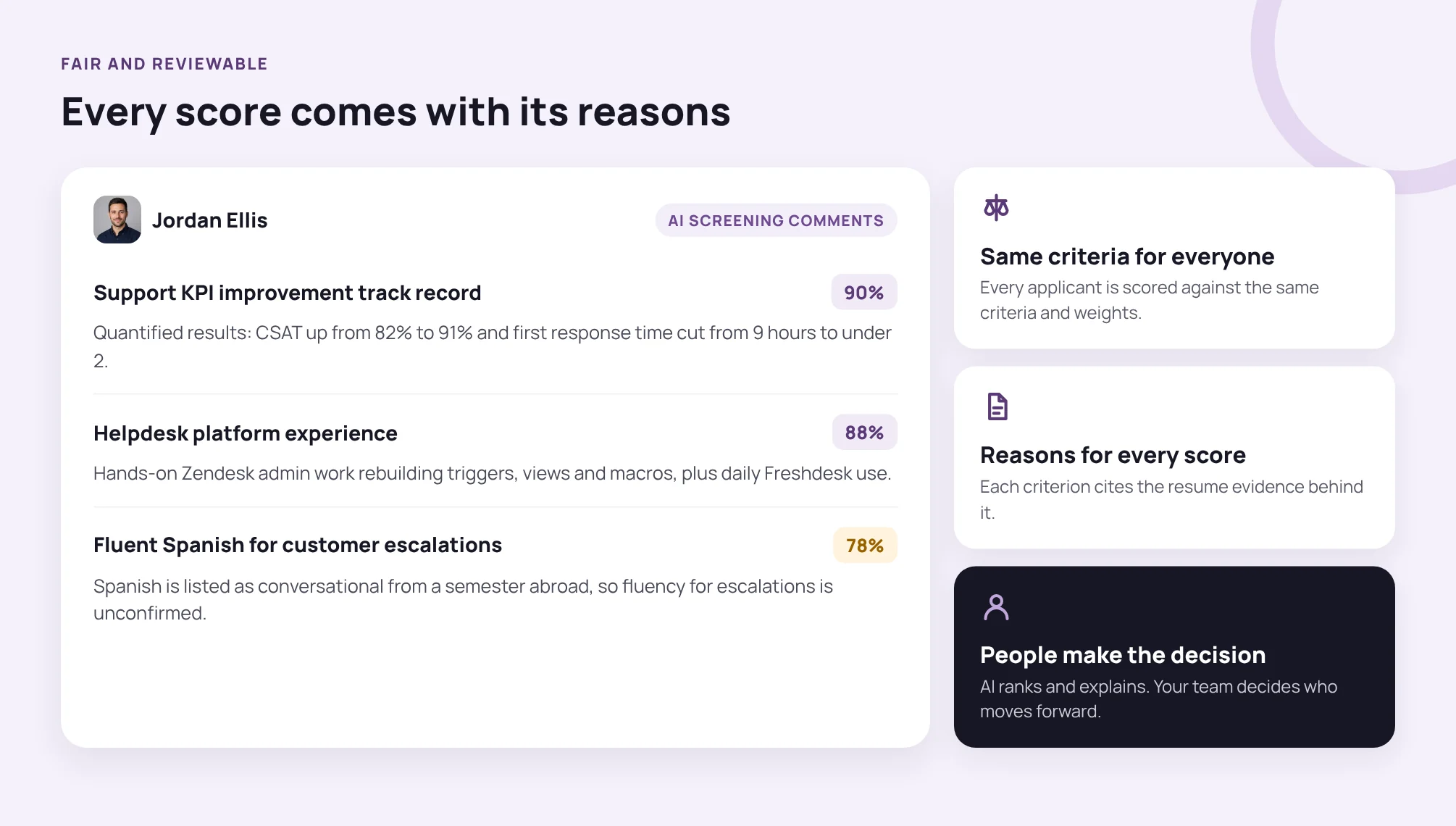
Language as its own criterion: “Fluent Spanish for customer escalations” is scored separately from the job skills, with the reason shown.
2. Have a fluent colleague read the translated questions. Ask them to flag three things: a question that got harder or vaguer, idioms that don’t translate (“walk me through”, “go the extra mile”), and the wrong level of formality. It takes about 15 minutes per question per language.
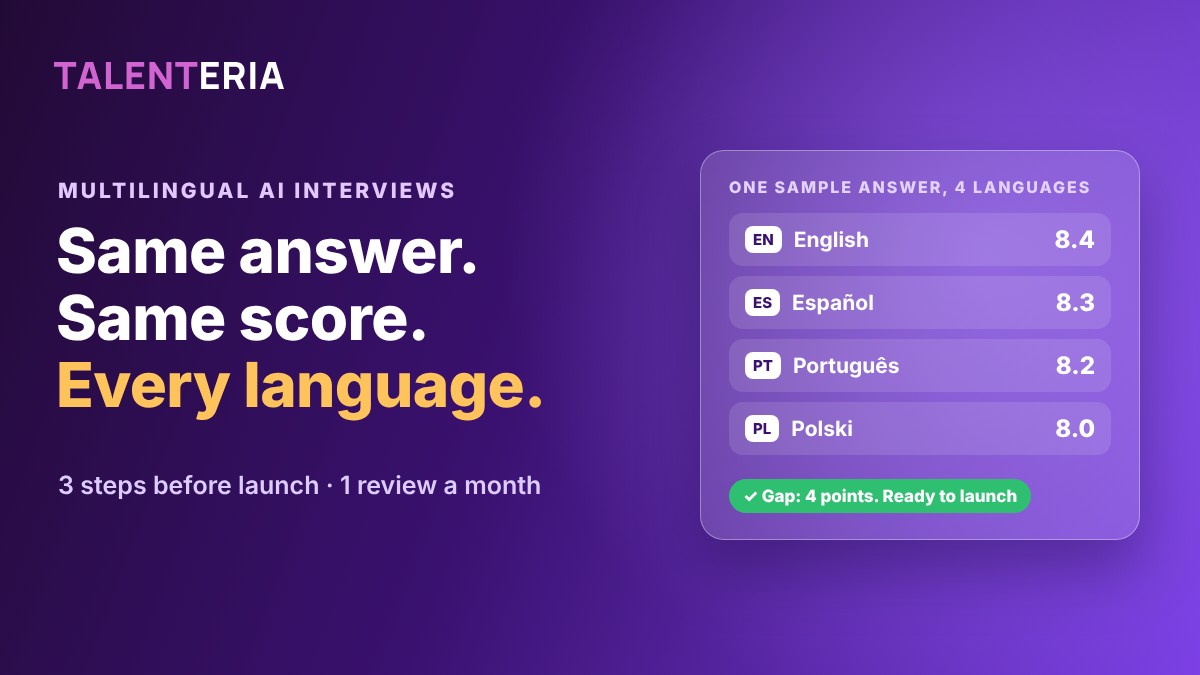
3. Score one sample answer in every language. Write one strong answer to each question. Have a fluent colleague record the same answer in each interview language, run it through the interview like a real candidate, and compare the scores:
| Score gap | What it means | Do this |
|---|---|---|
| 0–5 points | Comparable | Launch |
| 6–10 points | Borderline | Re-test after 50 interviews |
| Over 10 points | Not comparable | Fix wording first |
Gaps are on a 0–100 criterion scale. If the gap shows up on every criterion, the translation is the problem. If it shows up only on communication, the criterion is rewarding delivery: rewrite it around what the candidate says.
Once a month: compare pass rates by language
Pull every completed interview for the role and work out the pass rate for each interview language. Then compare each one with the highest.
The yardstick is the four-fifths rule from the US Uniform Guidelines on Employee Selection Procedures: a group whose selection rate is under 80% of the top group’s rate is generally treated as evidence of adverse impact. It was written for race, sex and ethnic groups, but interview language often tracks national origin, so it makes a sensible first screen.
Worked example: one role, four languages, 90 days
A customer support team lead role ran AI interviews in four languages. Recruiters advanced candidates scoring 7.0 or higher after review.
| Language | Interviewed | Advanced | Pass rate | Ratio |
|---|---|---|---|---|
| English | 160 | 64 | 40.0% | 1.00 |
| Spanish | 90 | 34 | 37.8% | 0.94 |
| Portuguese | 55 | 15 | 27.3% | 0.68 |
| Polish | 28 | 10 | 35.7% | too few |
Portuguese: 15 ÷ 55 = 27.3%. English, the highest: 64 ÷ 160 = 40.0%. Ratio: 27.3 ÷ 40.0 = 0.68, below the 0.80 line. Polish has fewer than 30 interviews, so don’t compute a ratio yet; wait for more data.
A flag is not a verdict. With only 55 Portuguese interviews, the gap could still be noise (a two-proportion test gives p ≈ 0.09). That’s a reason to look closer now, not to conclude anything. The quickest way to look closer is to compare average scores per criterion:
| Criterion | English | Portuguese | Gap |
|---|---|---|---|
| Product knowledge | 72 | 71 | −1 |
| Problem solving | 68 | 66 | −2 |
| Communication | 74 | 59 | −15 |
| Motivation | 70 | 69 | −1 |
Content scores are level; only communication drops. That points to the scoring, not weaker candidates. In this example, the sample answer scored 81 on communication in English and 62 in Portuguese. The criterion read “communicates clearly and confidently.” The team rewrote it as “explains the steps in order and checks the customer understood,” and the gap fell to 4 points. They then re-reviewed the 12 Portuguese candidates who had scored between 6.0 and 6.9.
One rule for every month: when a candidate scores within 1 point of your cut-off, or is rejected mainly on language, a fluent colleague reads the transcript before the decision.
How to do this in Talenteria
Talenteria runs AI interviews in the candidate’s language and scores every language against the same job criteria:
- Language per interview. When you create an AI interview, you choose the interview language from 16 options, including Spanish, Portuguese, Polish, German, French, Arabic and Hindi. The questions are translated into it.
- Expected answers per question. Each question can carry an expected answer that the AI uses as its yardstick.
- Criteria you control. The job’s evaluation criteria are set in the job’s AI Interview step. Add the language requirement as its own criterion and phrase communication criteria around content.
- Evidence you can check. Each criterion gets a 0–100 score, an explanation, and up to three quotes checked against the transcript. The explanation is written in your team’s language, but quotes stay in the candidate’s own words, which is what a fluent reviewer needs. See how the AI interview is scored.
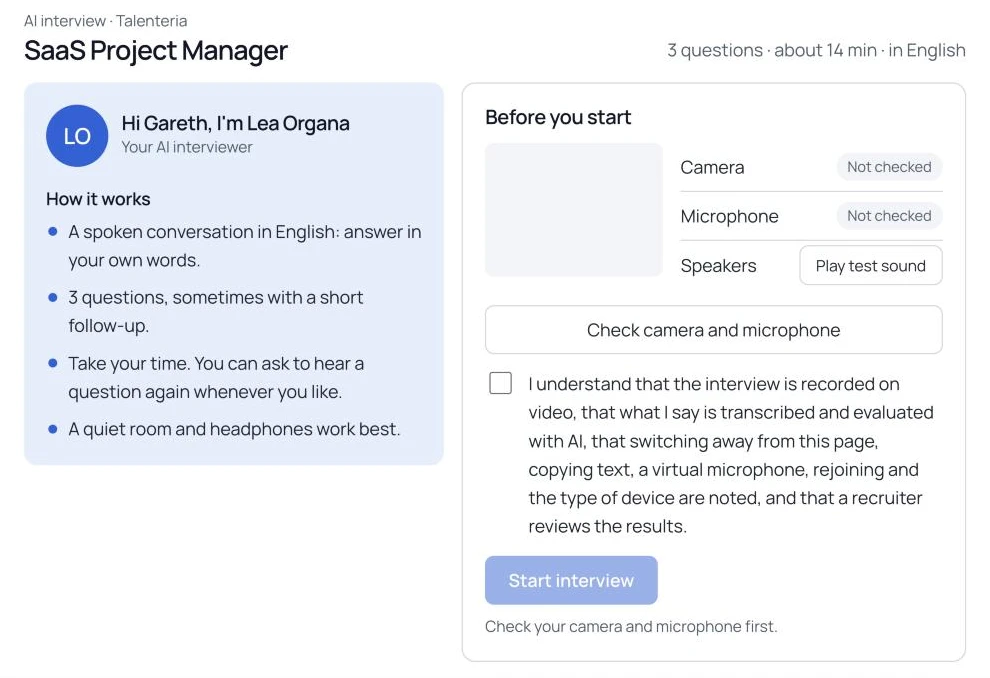
The candidate sees the interview language and length up front, and agrees to recording, transcription and AI evaluation before starting.
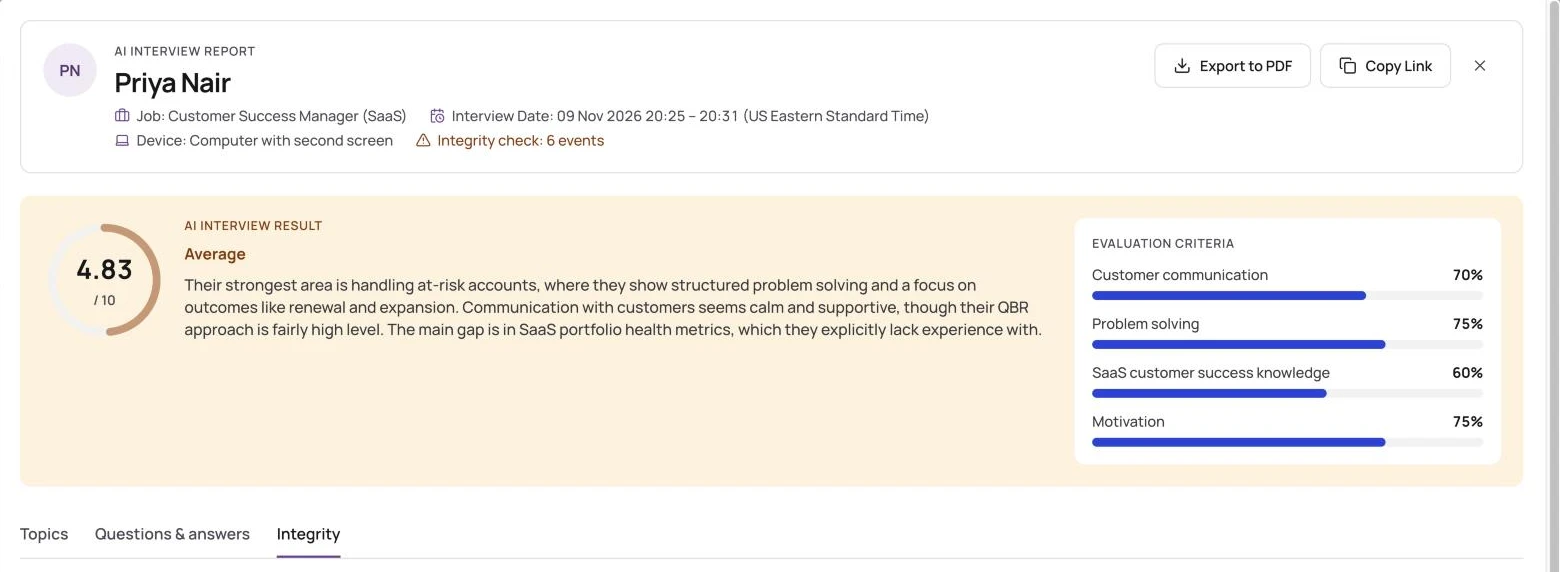
Criterion-level scores are what you average by language in the monthly review.
The AI scores and explains; it never advances or rejects anyone. Your recruiters make the call. For screening before the interview, AI resume screening reads resumes in 50+ languages against the same criteria.
Checklist to copy
Before launching a language:
- The job’s language requirement is its own criterion
- A fluent colleague has read every translated question
- One sample answer scores within 5 points across languages
Every month:
- Pass rate per language, ratio to the highest (flag under 0.80, skip groups under 30)
- Criterion averages for any flagged language
- Fluent review for scores within 1 point of the cut-off
Make multilingual AI interviews fair on purpose
Multilingual AI interviews widen your talent pool only when a score means the same thing in every language. Three steps before launch and a 30-minute monthly review are enough to catch most problems before candidates do.
For more on cut-offs and bias checks, see candidate scoring: weights, cut-off scores and a bias check. For reviewing integrity signals fairly, see AI interview cheating: how to review integrity flags.
Want to see this on your own roles? Talenteria screens and interviews candidates in their language and gives your team one ranked shortlist with the reasons behind every score.